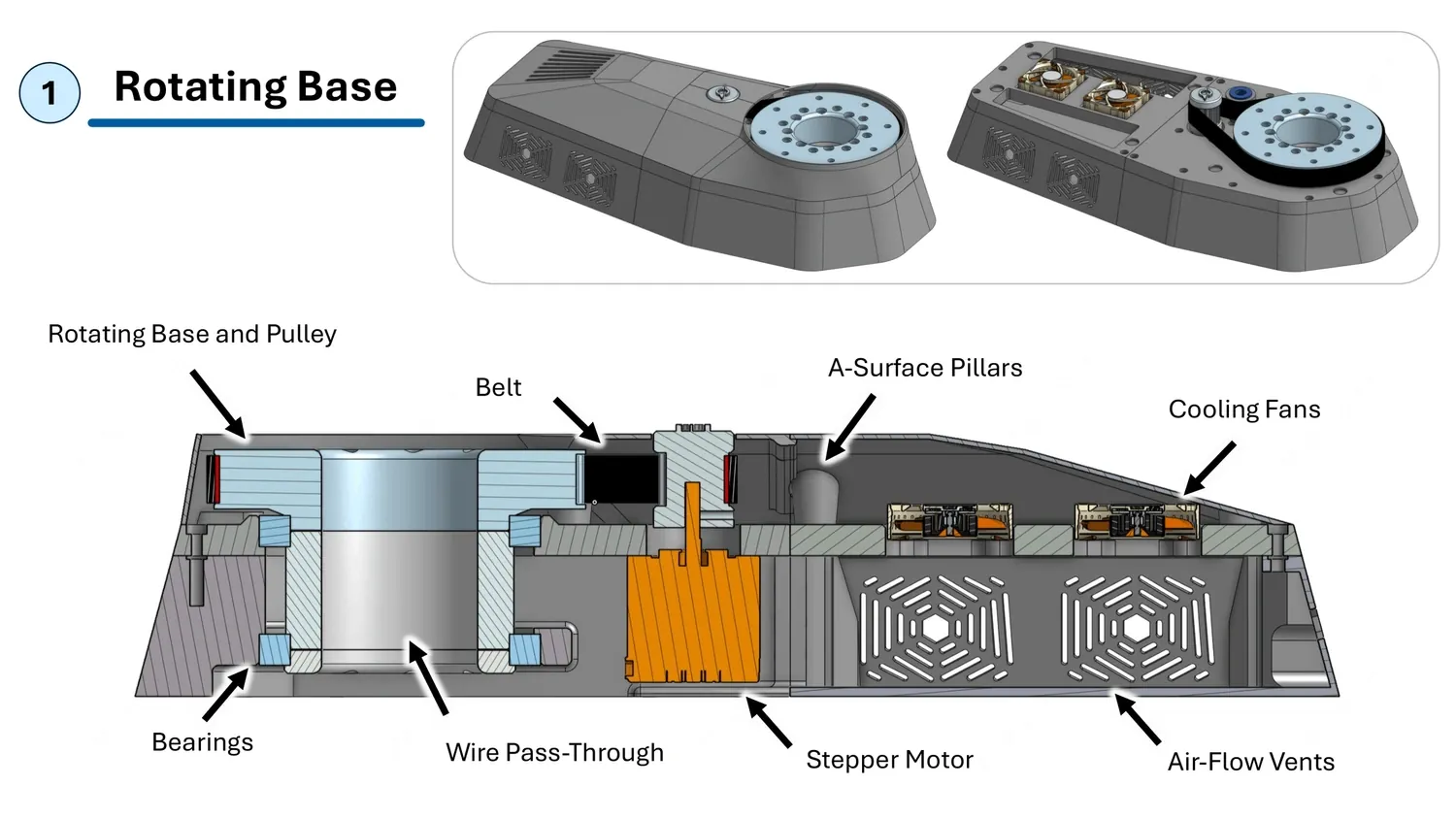
Rotating base
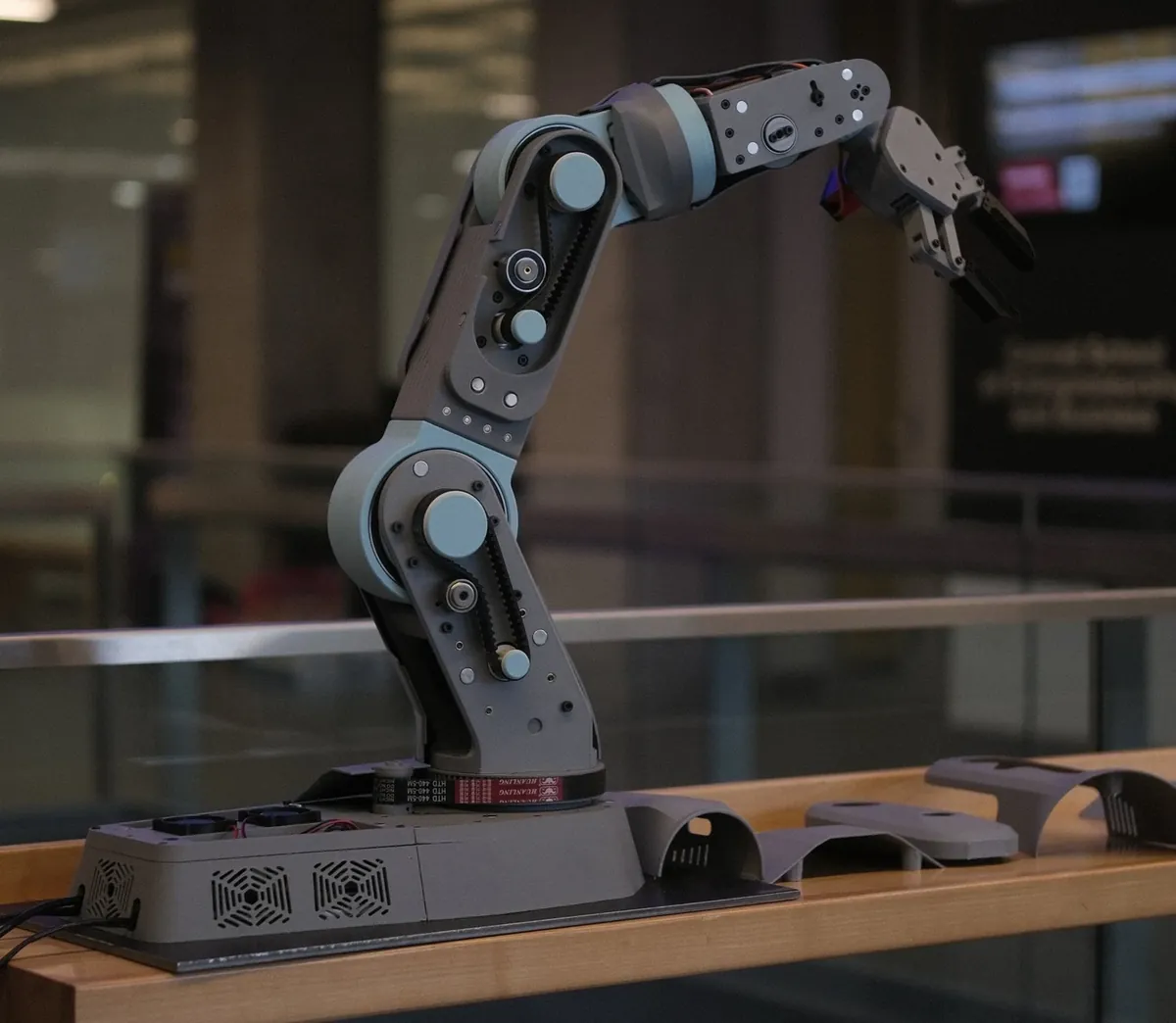
A belt drive turns the whole arm on bearings. The base also holds the electronics, with two fans pushing air out through vents in the side.
NEMA 17 · 5:1 belt · 1.9 Nm · ±170°
Personal project · 2026
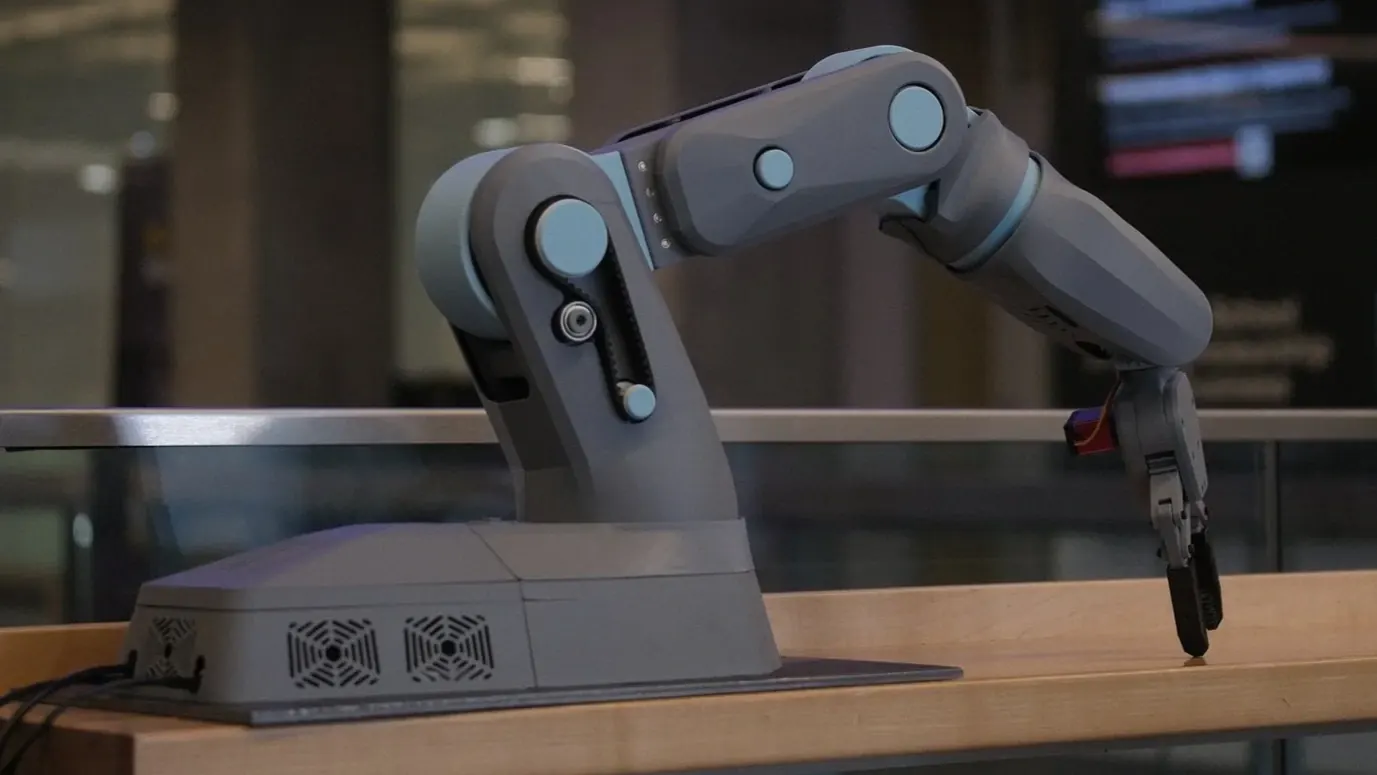
A six-axis arm built around custom 3D-printed cycloidal and planetary gearboxes. It lifts 3 kg, reaches 690 mm and repeats to about 1 mm, and the parts cost $296.70.
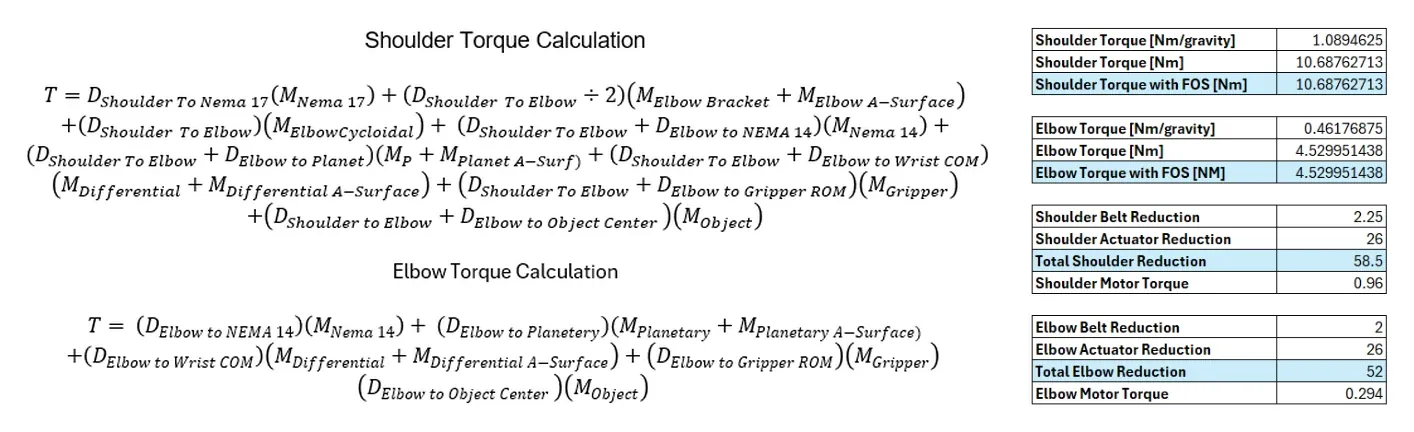
I started from constraints and criteria, then sketched the layout and ran first-principles torque calculations for every joint before modelling anything in Onshape. Those numbers set the motor sizes (a NEMA 23 at the shoulder, NEMA 17s and a NEMA 14 further out) and the reductions, up to 58.5:1 at the shoulder.
Everything is designed for 3D printing around off-the-shelf bearings, belts and motors, which made each iteration quick to print and test.
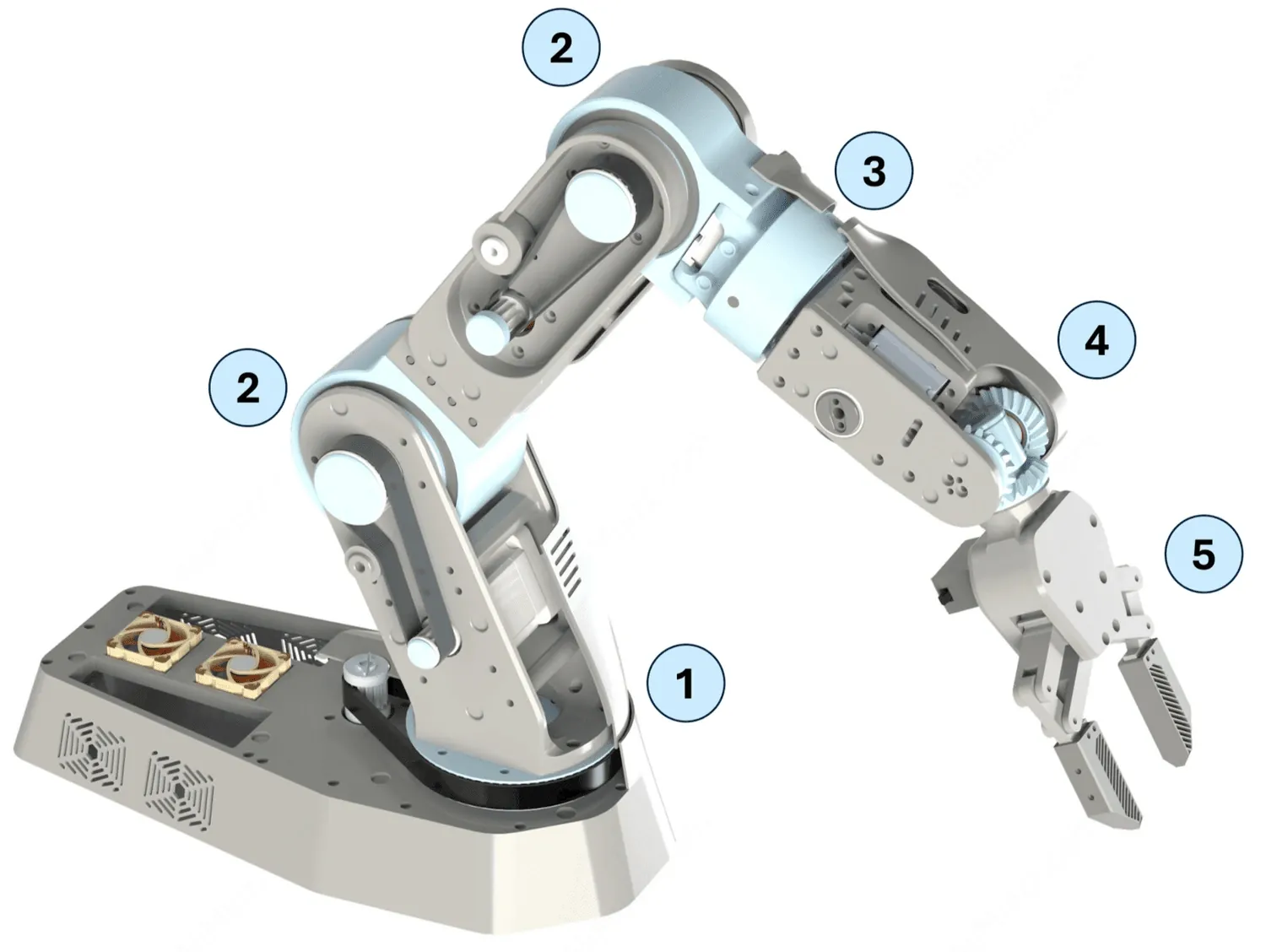
Pick a number on the render or a subsystem from the list.
A belt drive turns the whole arm on bearings. The base also holds the electronics, with two fans pushing air out through vents in the side.
NEMA 17 · 5:1 belt · 1.9 Nm · ±170°
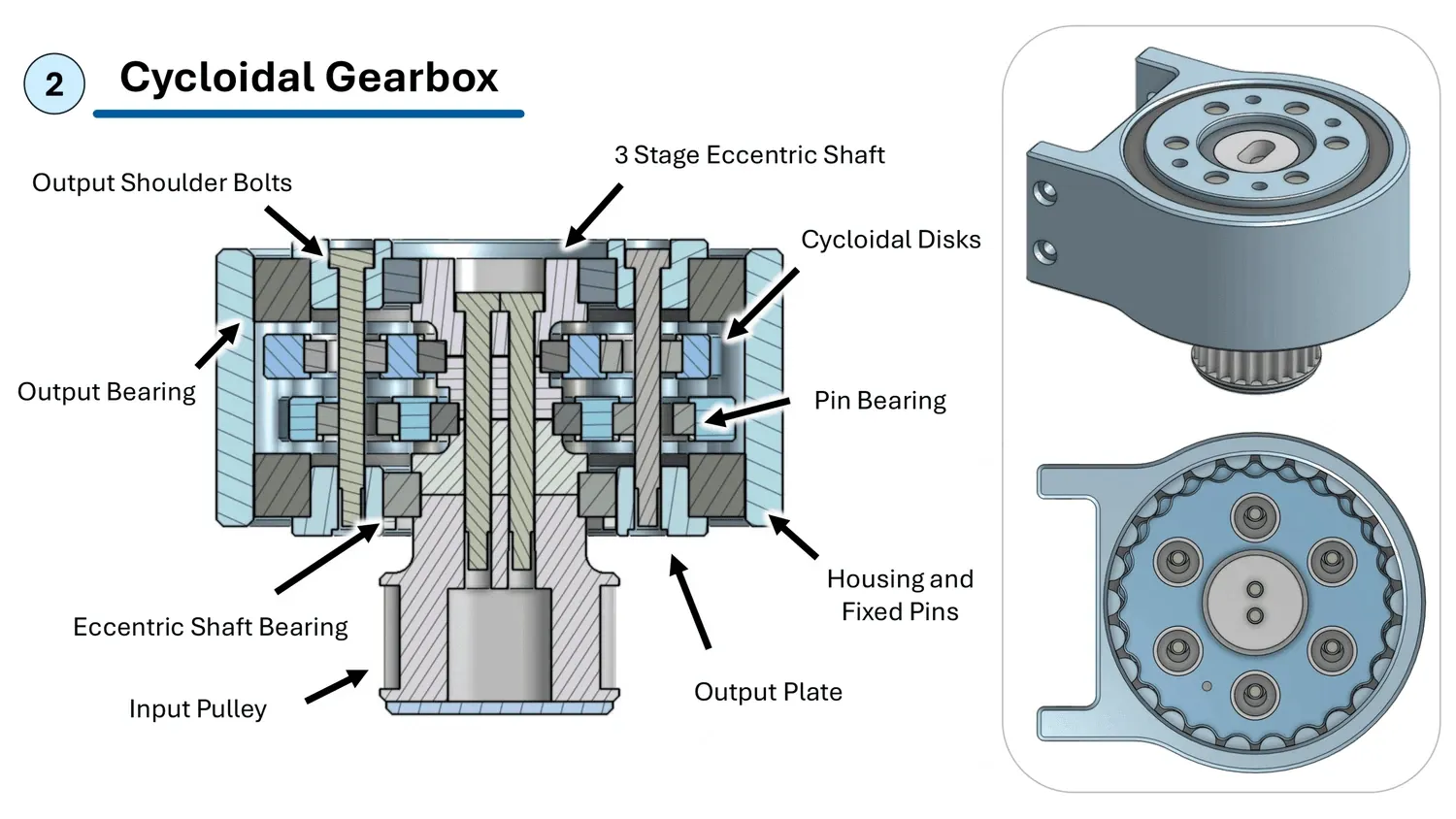
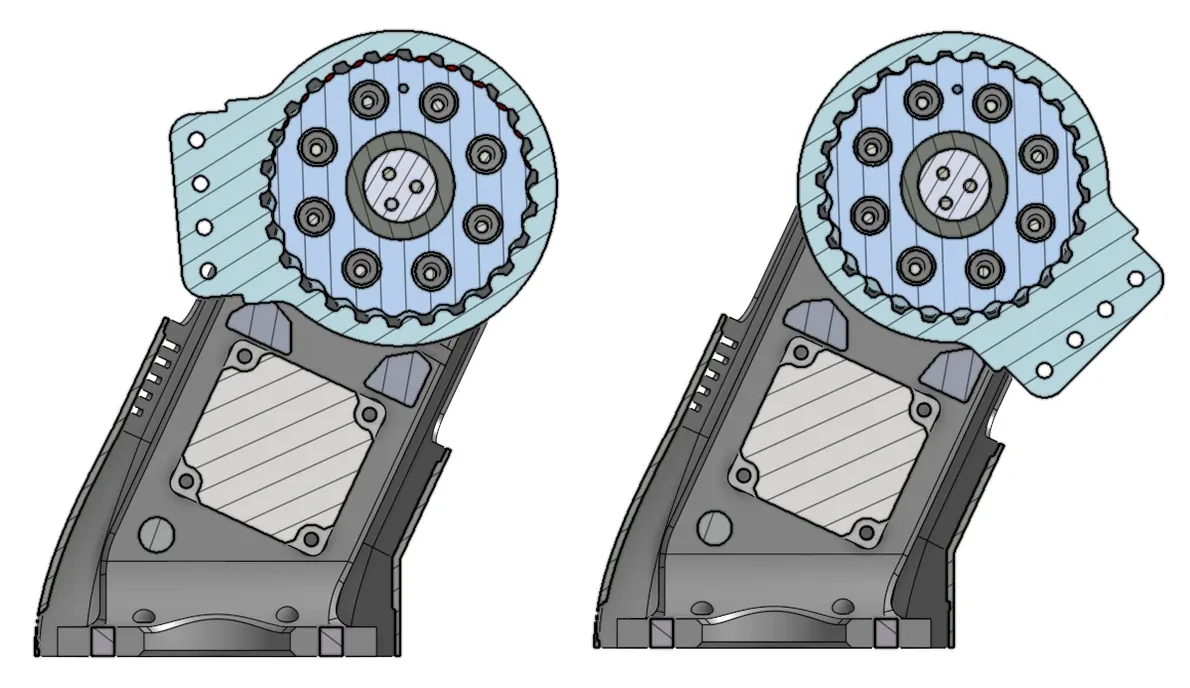
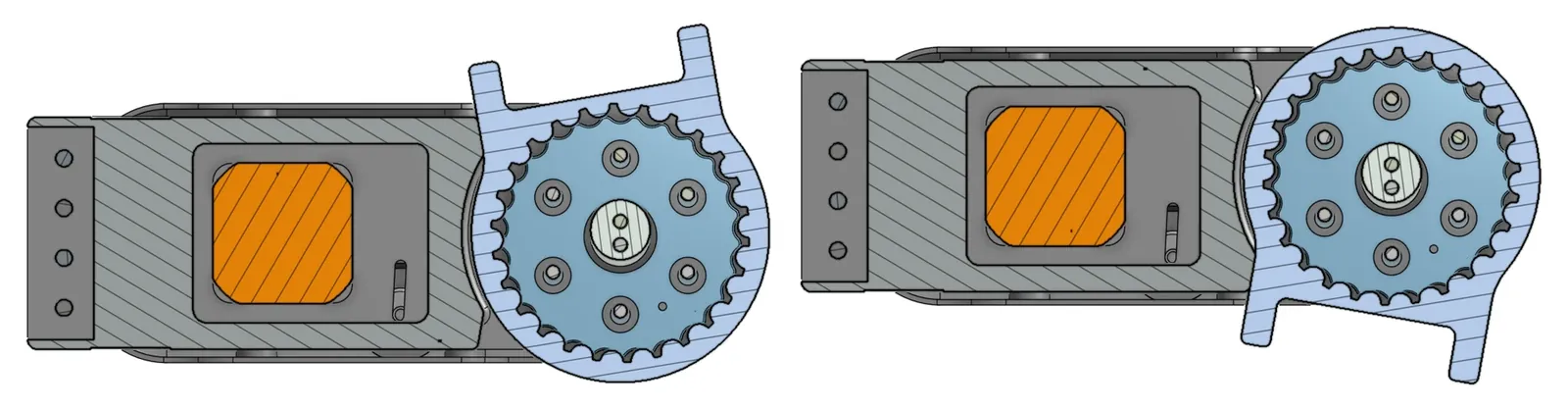
Used at the shoulder and the elbow. A belt drives the eccentric input shaft, and the cycloidal discs roll against fixed pins in the housing. The housing is the output, so the gearbox doubles as the joint.
Shoulder · NEMA 23 · 58.5:1 · 30 Nm · −5° to 225°
Elbow · NEMA 17 · 52:1 · 8.3 Nm · ±100°
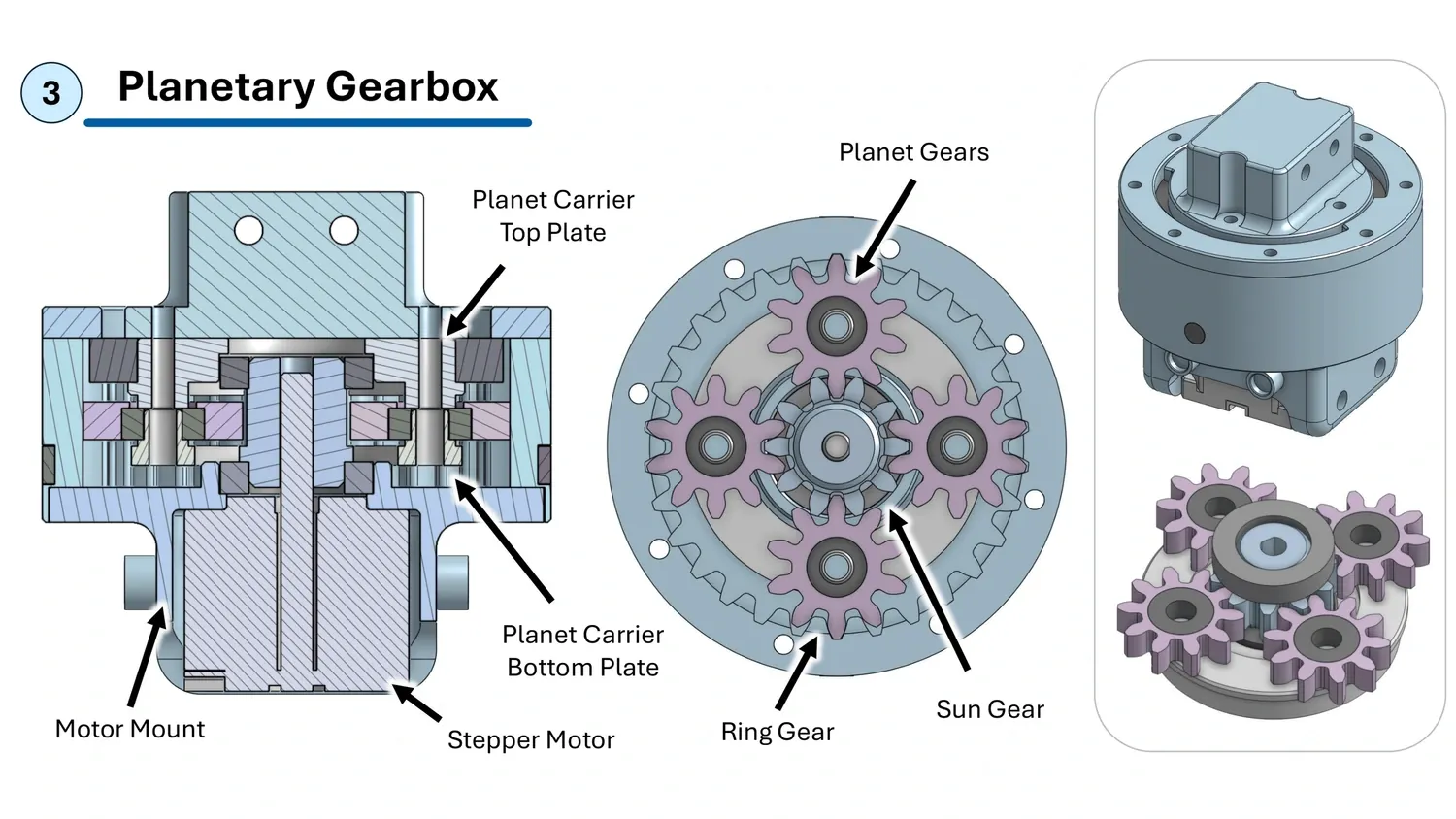
The sixth axis. A planetary stage rolls the forearm so the gripper can tilt sideways as well as up and down.
NEMA 14 · 4:1 · 0.56 Nm · ±150°
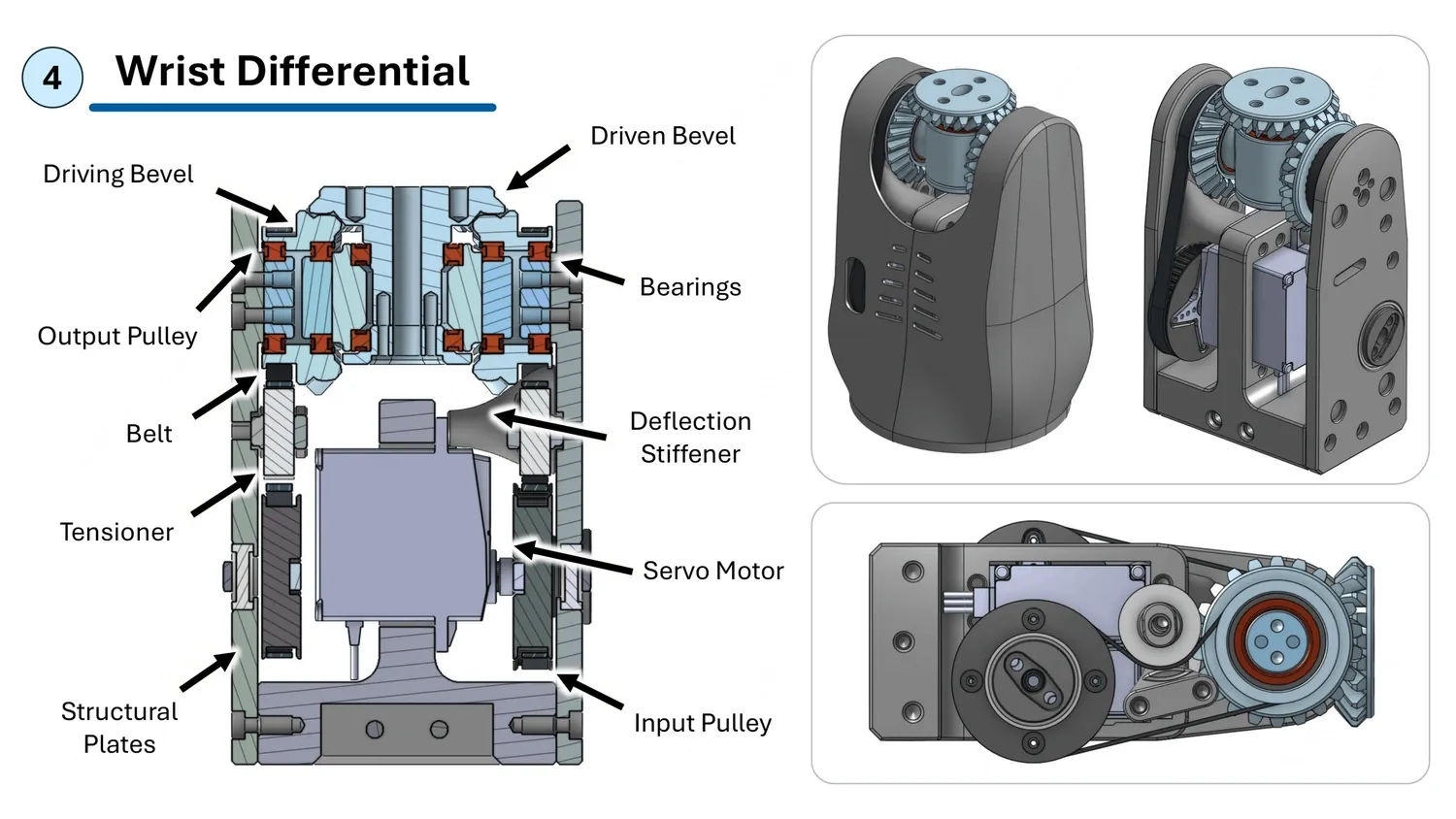
Two servos drive a set of bevel gears. Turning both the same way pitches the wrist, and turning them in opposite directions rolls it.
2 × 25 kg·cm servos · 2.6 Nm · pitch ±90°, roll ±170°
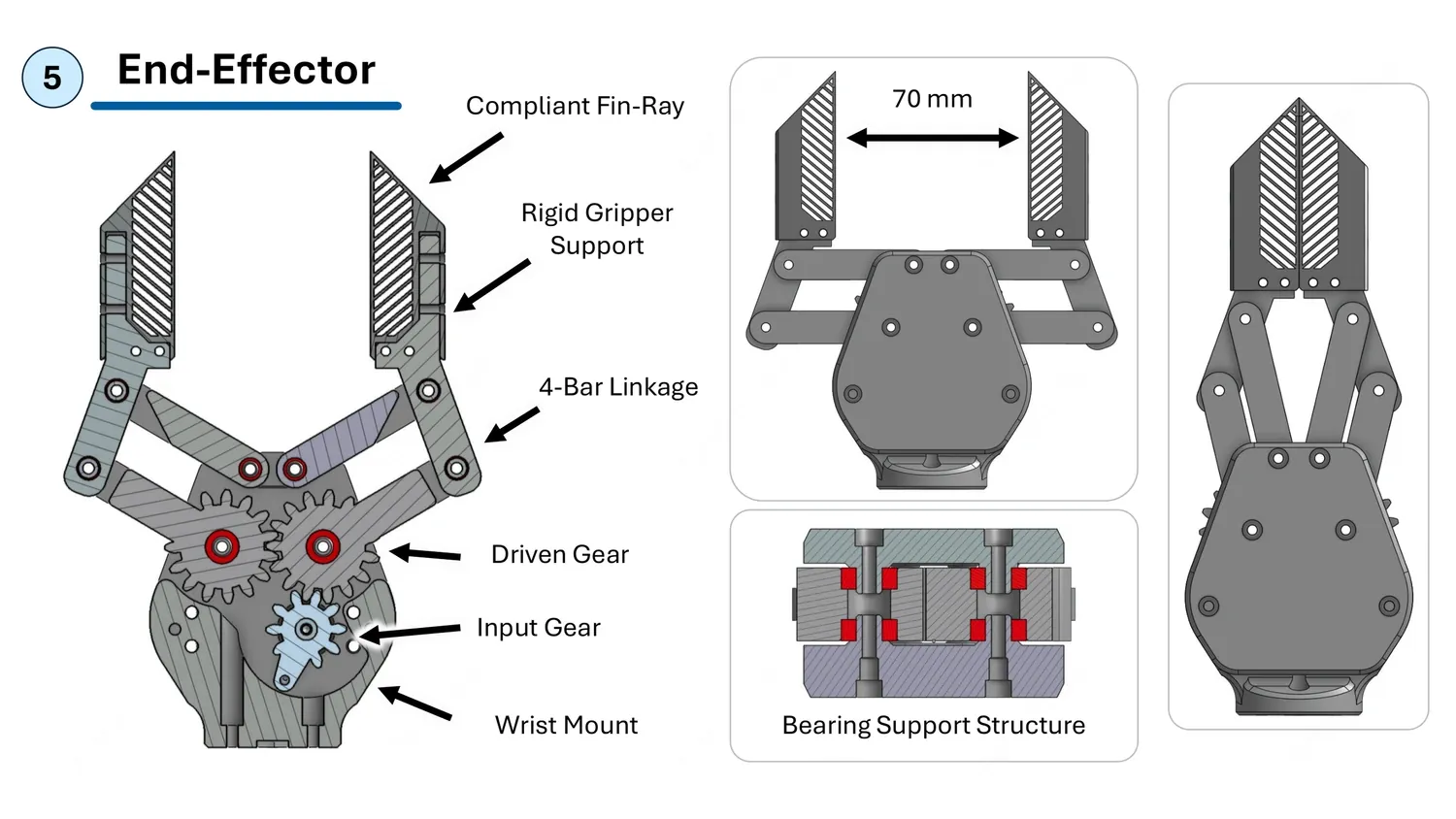
A parallel four-bar keeps the fingers parallel as they close. The fin-ray fingers bend around whatever they grab, so it can hold an egg, a pencil or a billiard ball.
20 kg·cm servo · 70 mm opening
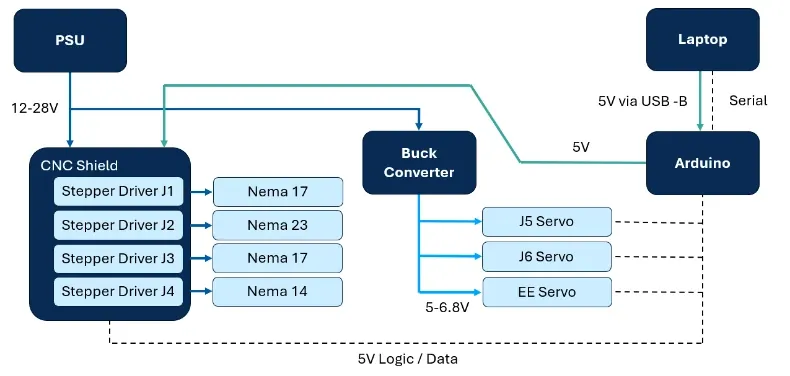
I owned the electrical side, from the schematics for 4 stepper motors and 3 servos through the wiring and the robot control firmware. The steppers run on TMC2209 drivers on an Arduino CNC shield, each current-limited below its rating so nothing overheats, and a buck converter drops the supply voltage for the servos.
Inverse kinematics I wrote runs on a laptop and streams joint targets to the Arduino over serial. The arm runs a homing sequence at startup, and the wrist uses servos so it never needs homing.
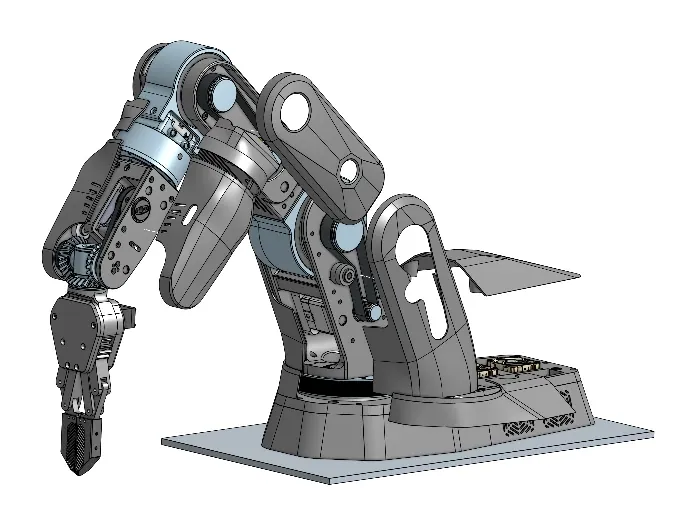
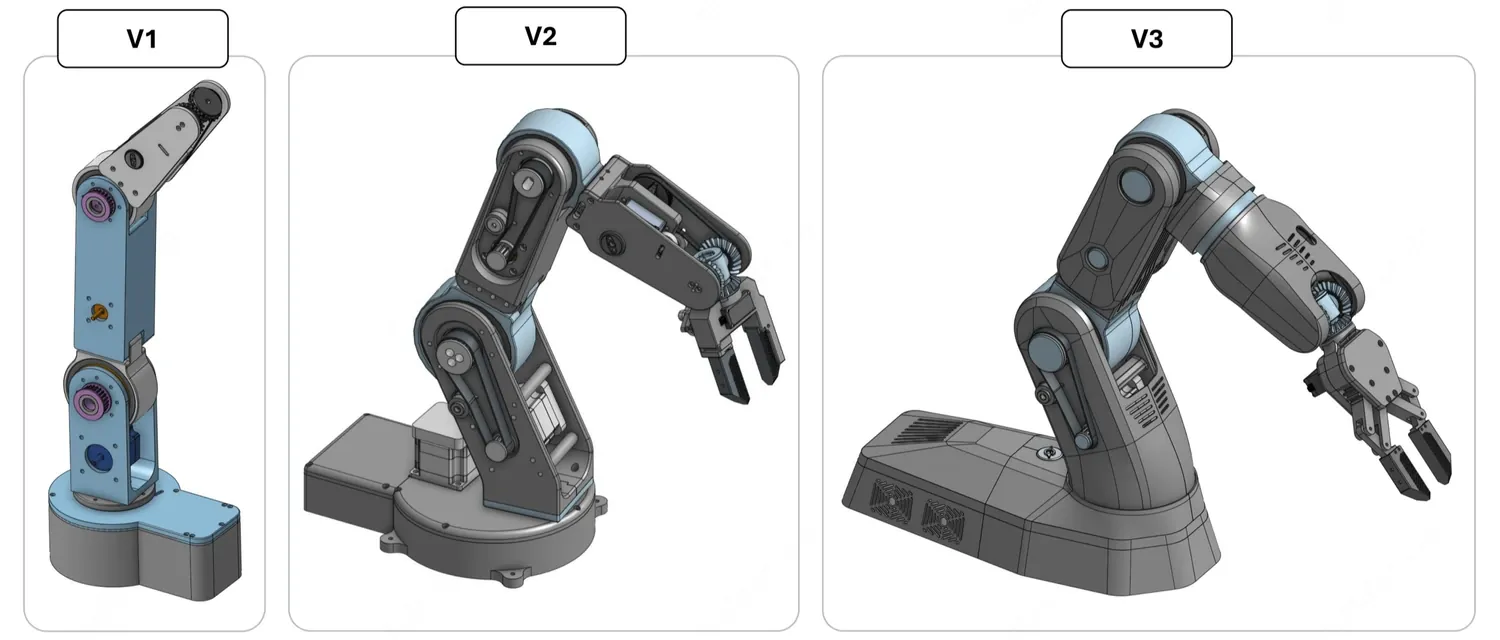
The arm went through three versions. Later ones added mechanical hard stops, two cooling fans in the base, and magnetic cover panels that snap on with clearance for the moving parts and wires, and come off for repairs.
Each design spec had its own test.
| Spec | Target | Result |
|---|---|---|
| Reach | Over 0.40 m | 0.69 m |
| Approach orientations | 10 | 10 |
| Degrees of freedom | 6 | 6 |
| Repeatability | Within 5 mm | 1.08 mm average |
| Grasp time | Under 2 s | 0.5 s |
| Pick and place cycle | Under 25 s | 20 s |
| Largest object | Over 30 mm | 70 mm |
| Parts cost | Under $300 | $296.70 |
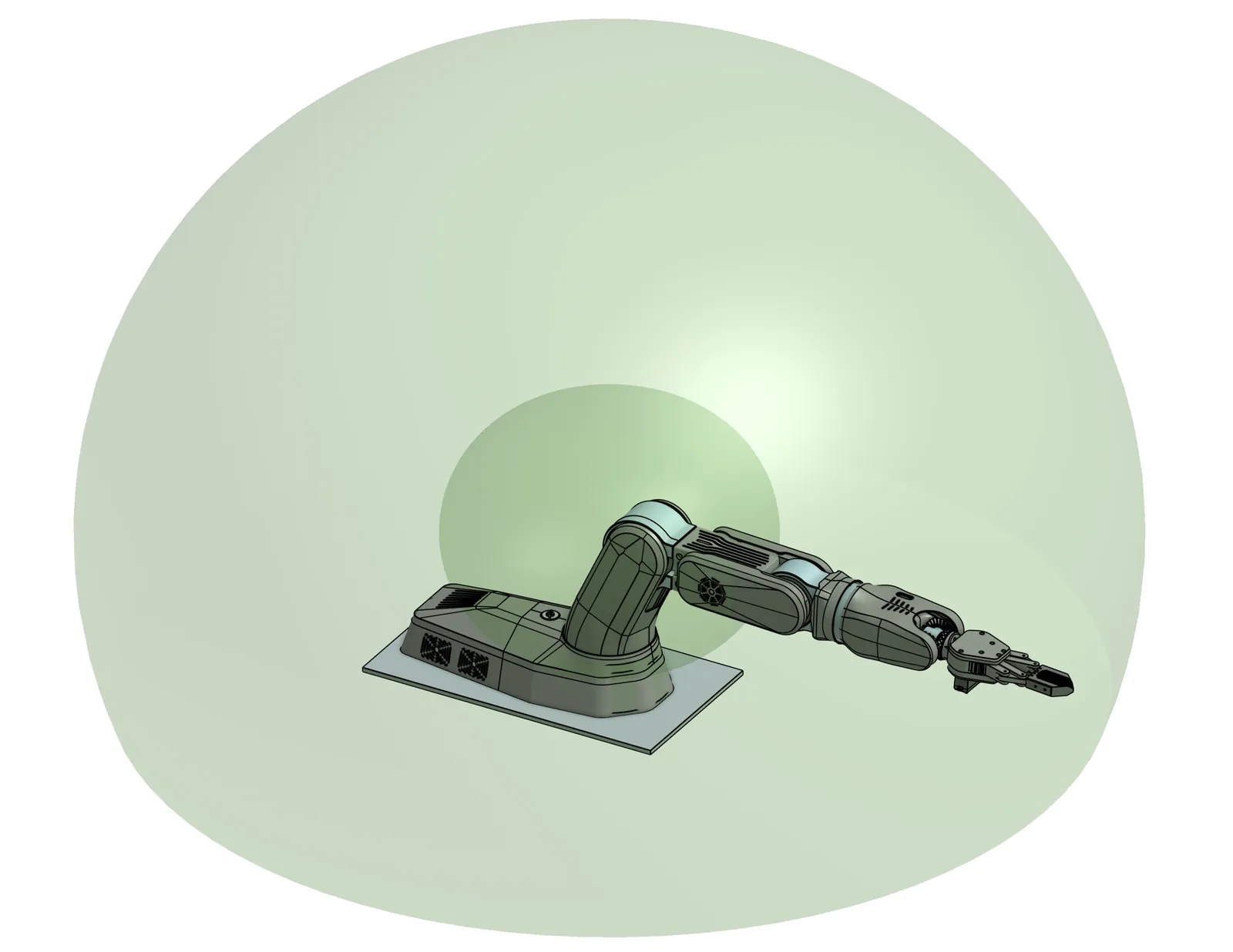
The arm reaches from 22 mm to 690 mm out from the base axis. Every joint has a mechanical hard stop at its limit, which lets the arm zero itself against them.
The target was 10 orthogonal approach orientations, up from 4 once the sixth axis went in. The arm reached all 10.
FIG. 11 Approaching objects from different directions.
The fin-ray gripper was tested on ten objects, from a 3D-printed Benchy to an egg, a pencil and a knife.
FIG. 12 The ten gripping tests, in rough order of difficulty.
The shoulder lifted 3 kg, and the shoulder and elbow each held 1.5 kg at full reach. At 3 kg the wrist starts to flex.
A dial indicator measured how close the arm returns to the same point. It moved away and back four times, and the average error was 1.08 mm against a 5 mm target.
| Cycle | Error |
|---|---|
| 1 | 0.5 mm |
| 2 | 2.0 mm |
| 3 | 1.7 mm |
| 4 | 0.1 mm |
| Average | 1.08 mm |
| Joint | Actuator | Reduction | Expected torque (Nm) | Range |
|---|---|---|---|---|
| Base | NEMA 17 stepper | 5:1 belt | 1.89 | ±170° |
| Shoulder | NEMA 23 stepper | 58.5:1 belt + cycloidal | 30.33 | −5° to 225° |
| Elbow pitch | NEMA 17 stepper | 52:1 belt + cycloidal | 8.26 | ±100° |
| Elbow roll | NEMA 14 stepper | 4:1 planetary | 0.56 | ±150° |
| Wrist pitch, roll | 2 × 25 kg·cm servo | Bevel differential | 2.57 | ±90°, ±170° |
| Gripper | 20 kg·cm servo | Parallel four-bar | 70 mm opening |
Total $296.70 in parts. The arm weighs 5.5 kg, or 11.3 kg on its steel base plate.